DEFECTION: NNPP SAYS FEDERALISM IN NIGERIA REDUCED TO ‘PRINCIPAL AND CLASS CAPTAINS’ AFTER YUSUF’S EXIT TO APC
Written by Oluwaseyi Amosun on January 27, 2026

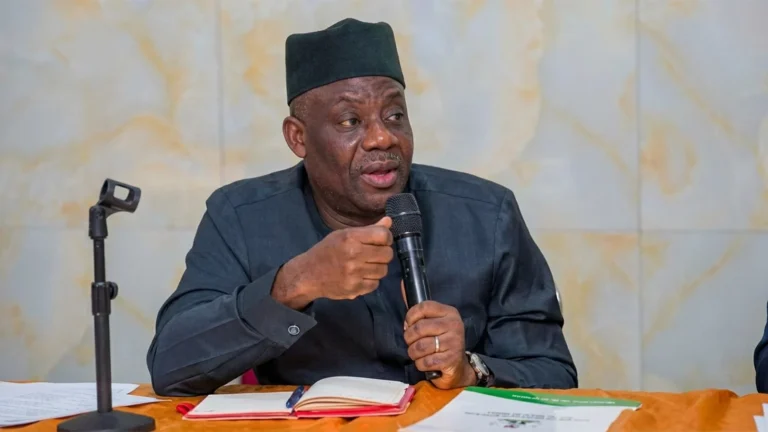
Image of the National Secretary of the New Nigeria Peoples Party (NNPP), Dipo Olayoku
The New Nigeria Peoples Party (NNPP) has condemned the defection of Governor Abba Kabir Yusuf to the ruling All Progressives Congress (APC), accusing the current federal system of undermining true federalism and reducing state governors to mere subordinates of the presidency.
The party’s National Secretary, Dipo Olayoku, spoke on Frontline on Eagle 102.5 FM, Ilese Ijebu on Tuesday, shortly after Yusuf’s official defection on January 26, 2026, a move he described as symptomatic of a broader collapse of constitutional federalism in Nigeria.
“This is Nigeria of today. We are supposed to have three tiers of government — national, state and local — each with constitutionally defined powers,” Olayoku said. “But unfortunately today, what we have in Nigeria is a principal, that is the president, and class captains, the governors. That is what the current administration has reduced our governors to.”
Governor Yusuf formally joined the APC alongside 22 Kano State House of Assembly members and nine federal lawmakers at an event held in the Coronation Hall of the Kano Government House. He said the decision followed extensive consultations and was aimed at strengthening governance and accelerating development in the state.
DEFECTON: SHOCKING BUT NOT ENTIRELY UNEXPECTED
Olayoku said the defection was not entirely surprising but remained unsettling for party leadership.
“It didn’t come as a surprise, but it is shocking,” he said, recalling that hints of a possible defection had surfaced more than a year ago.
“It’s important to understand that Governor Aba Kabir Yusuf’s defection wasn’t something we could have prevented. We did everything possible within our reach, but ultimately, the decision was his. There are pressures in our democracy today that make situations like this inevitable. We’ve seen similar cases, like Governor Siminalayi Fubara in Rivers State, and the pressures from the ruling party can be intense.”
He claimed that Governor Yusuf had faced intense pressure from external forces and persistent obstruction by federal institutions, which he argued made governance difficult.
“If you have a governor that will give an order and the Commissioner of Police counter it, then it tells you the type of democracy we are on,” Olayoku said.
“This isn’t about mismanagement; it’s about the realities of the democracy we practice in Nigeria. The national security of the party and certain sensitive factors prevent me from going into all the details publicly. But Nigerians should pay attention to the forces at play that are influencing governors to move to the APC.”
CONTINUING POLITICAL REALIGNMENT
Yusuf is the eighth state governor to defect to the APC since April 2025, following transitions by governors in Delta, Akwa Ibom, Enugu, Bayelsa, Plateau, Rivers, and Taraba states. The trend has fuelled speculation about the diminishing strength of opposition parties ahead of the 2027 general elections.
FEDERAL INTERFERENCE AND ELECTORAL DISPUTES
Revisiting the 2023 elections in Kano, Olayoku stressed the NNPP’s sweeping victories in the state, where the party won the presidential, governorship and other major contests. He accused the Independent National Electoral Commission (INEC) and judiciary at the appeal level of manipulating results to favour the APC, allegations that underscore longstanding grievances about electoral integrity.
“In 2023, there were five elections in Kano, and NNPP won all of them. We won the presidential election in the state, the two National Assembly seats, and the governorship. During the governorship election compilation, APC tried to manipulate the process. For instance, the person handling the compilation suddenly said he needed to leave, which could have disrupted the results. But our team stayed vigilant, and ultimately, the results were announced in our favor.”
“Afterward, APC challenged the outcome in court, arguing that our governor wasn’t a legitimate party member and that some ballot papers were improperly stamped. These matters were already settled by the Supreme Court. The court confirmed that party membership cannot be challenged by someone outside the party, and valid ballots should count even if minor errors existed. In the end, the Supreme Court returned the mandate to NNPP, validating the people’s choice in Kano.”
Olayoku warned that the trend of defections reflects a threat to Nigeria’s multiparty democracy, one that goes beyond party politics.
“It is not a lesson for NNPP. It is a wake up call to Nigerians,” he said. “Multi party democracy in Nigeria is under serious threat.”
He likened the weakening of opposition structures in states like Lagos to a nationwide trend that could erode accountability and healthy political competition.
GOVERNOR’S JUSTIFICATION
At the defection ceremony, Governor Yusuf defended his decision as being in the best interest of peace, unity, stability and sustainable development for Kano State. He said aligning with the ruling party and federal government would enhance cooperation and attract development opportunities.
DEMOCRACY UNDER THREAT
The NNPP National Secretary warned that Nigeria’s multi-party democracy is under serious threat, insisting that the issue goes beyond party politics.
“It is not a lesson for NNPP. It is a wake-up call to Nigerians,” Olayoku said. “Multi-party democracy in Nigeria is under serious threat.”
“Our democracy in Nigeria today is under serious strain. Federalism means that the federal, state, and local governments each have defined powers. But when a president reminds governors, “I am the president and commander-in-chief,” and pressures them to act a certain way, it undermines that system. The balance of powers is clear in law, but in practice, it’s being challenged. That’s not the kind of democracy Nigerians fought for in 1999. Multi-party democracy is under threat when opposition parties and their leaders can’t operate freely without intimidation or pressure.”
He drew parallels with political developments in Lagos State, arguing that opposition parties are being systematically weakened nationwide.
ECONOMIC HARDSHIP AND GOVERNANCE
Olayoku also questioned claims by the APC that the current administration is performing well, citing rising living costs.
“If you go to the market now and price things, you’ll see what Nigerians are really experiencing. People often say, “Oh, you don’t expect prices to remain the same after the fuel subsidy was removed.” But that’s not an achievement—it’s suffering. In 2012, fuel was 65 Naira; under President Jonathan, it went to 141 Naira. The current administration came in May 2023, and within three months, fuel jumped from 187 Naira to 1,000 Naira.
When the government says it is “doing well,” I ask: doing well for whom? Nigerians are struggling. People in the market, families trying to survive—they know the reality. Doing well has a very different meaning when you compare it to what people are actually experiencing,” he said.
“Go to the market now and price things.”
He criticised the removal of fuel subsidy, noting its impact on ordinary Nigerians.
“Fuel moved from ₦187 to ₦500, and within three months it jumped to ₦1,000,” he said.
“Doing well has a different meaning.”
REACTIONS FROM RESIDENTS AND POLITICAL STAKEHOLDERS
Listeners who called into the Frontline programme expressed concern about the political direction of the country. One caller, Abdulwasi from Ilese, warned against the dangers of a de facto one party system.
“Nigeria is drifting towards one political party, and that is dangerous to our political system,” he said. “Democracy thrives on strong opposition. Without it, accountability collapses.”
Meanwhile, APC leaders in Kano hailed Yusuf’s defection as a turning point in the state’s politics, viewing it as an endorsement of the APC’s agenda and governance style.
2027 ELECTIONS AND NNPP’S POSITION
Looking ahead to the 2027 general election, Olayoku said the NNPP remains focused and undeterred by the governor’s defection.
“Come 2027, it is not APC versus NNPP,” he said.
“It is NNPP versus Abba Kabir Yusuf. The sympathy for our party remains strong in Kano, especially because the people sent a clear message in 2023 that they didn’t want APC. The party itself isn’t feeling betrayed; it’s about the people and their mandate. Aba Yusuf is an experienced politician, and while he has left, not everyone followed him.
He stressed that the party does not feel betrayed.
“A politician can go anywhere,” he said.
“But the people of Kano sent a message in 2023 that they do not want APC.”


 Eagle Fm