OSUN 2026: HOW THE ELECTORAL ACT 2026 WILL SHAPE THE GOVERNORSHIP ELECTION
Written by Oluwaseyi Amosun on August 14, 2026
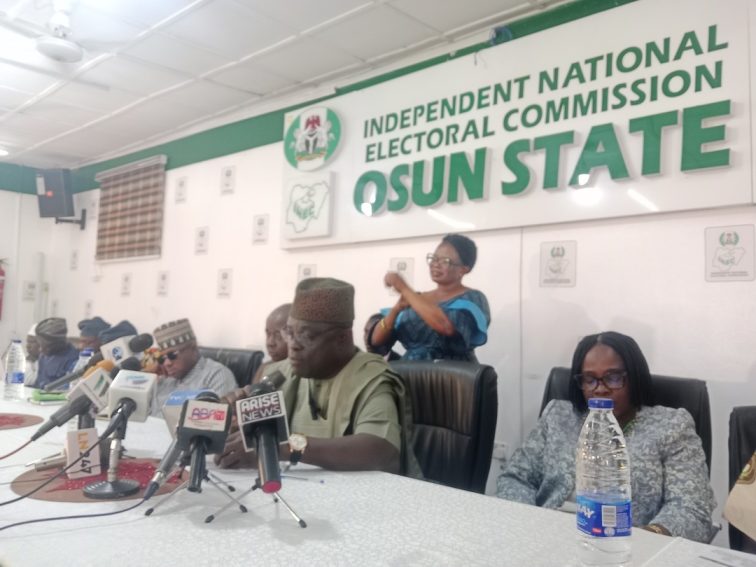
Photo File: INEC Osun
By Oluwatishe Yusuf and Adegoke Opeyemi
When voters across Osun State go to the polls on Saturday, August 15, to elect a governor for the next four years, they will be participating in more than another off-cycle governorship election. The poll will be the second major governorship election in Nigeria conducted under the Electoral Act 2026, following the June 20 governorship election in Ekiti State, and will provide another opportunity to test how the country’s latest electoral reforms work in practice.
The Electoral Act 2026, signed into law on February 18, repealed the Electoral Act 2022 and introduced a revised legal framework for the conduct of elections. It covers the process from voter registration and accreditation through voting, counting, result transmission, collation, electoral offences and election petitions. More importantly, it gives greater statutory weight to technology in the management of elections, including electronic transmission of polling-unit results and the creation of a National Electronic Register of Election Results.
For Osun, the significance of the new law is particularly important because the state is entering an election in which technology, security, political competition and the credibility of the final result will all be under intense scrutiny.
But the 2026 law should not be presented as though it has suddenly introduced BVAS or electronic results into Nigerian elections. Those technologies were already being used by INEC before the new legislation. What has changed is the legal architecture around their use and the extent to which electronic result management, verification and preservation have been written into the law. That distinction matters.
The real question facing Osun on Saturday is whether the combination of the new law, INEC’s technology, trained election officials, security agencies, political parties and voters can produce an election whose results can be followed from the polling unit to the final declaration.
The law behind Saturday’s election
The Electoral Act 2026 is effectively the rulebook for Saturday’s election. It establishes procedures for voter accreditation, polling, counting, collation, result management and the conduct of political parties and candidates.
It also defines electoral offences and provides penalties for activities capable of undermining the integrity of the election, including bribery, undue influence, disorderly conduct, destruction of election materials and other forms of interference.
This means the law does not concern INEC officials alone. It affects virtually everyone involved in the electoral process — voters, candidates, political parties, polling agents, observers, security personnel and the media.
For voters, some of the provisions will be experienced directly at the polling unit. For political parties, they will shape the conduct of their agents and the management of results. For journalists, the law places boundaries around campaign reporting and political advertising, particularly as the election approaches and voting begins.
The effectiveness of the law will therefore depend less on what is written on paper and more on how consistently it is applied across Osun’s 30 local government areas, 332 registration areas and 3,763 polling units.
PVC collection does not mean automatic voting
INEC has put the number of registered voters in Osun at 2,339,233, while 1,906,390 Permanent Voter Cards have been collected ahead of Saturday’s election.
But having collected a PVC does not give a voter the freedom to vote at any polling unit of choice.
The Electoral Act requires voters to be properly registered and accredited before voting. The voter must also appear at the polling unit to which the voter has been assigned.
This is where the accreditation process becomes critical.
The new framework provides for the use of technology prescribed by INEC for voter accreditation, with BVAS serving as the principal instrument for authenticating voters. INEC Chairman Professor Joash Amupitan had similarly emphasised the principle in the preparations for the Ekiti election, stressing that voters must present themselves for the prescribed accreditation process before they can vote.
For the ordinary voter, the implication is simple: being registered is not enough. The voter must be properly accredited before receiving a ballot paper.
BVAS remains central, but it is not an electronic voting machine
One of the areas where confusion often arises is the role of the Bimodal Voter Accreditation System. BVAS does not replace the ballot paper. Voters will still receive physical ballot papers, mark them and place them in ballot boxes. BVAS is used principally to authenticate and accredit voters.
The technology has already been used in several Nigerian elections, and its deployment is therefore not an entirely new development in Osun.
What the Electoral Act 2026 does is place the technology within a broader statutory framework for election administration.
That makes Saturday’s election an important test of whether the technology can work reliably at scale.
The challenge is considerable. Osun has more than 2.3 million registered voters spread across 3,763 polling units. A problem affecting only a small percentage of polling units could still affect thousands of voters.
And that is precisely why the experience of Ekiti matters.
What Ekiti 2026 tells Osun about the new law
The June 20, 2026 Ekiti governorship election provides the most immediate reference point for Osun.
The election involved 1,059,360 registered voters, 177 registration areas and 2,445 polling units across 16 local government areas. INEC described itself as operationally, technologically and logistically ready for the election, with BVAS designated as the instrument for voter authentication and accreditation and polling-unit results scheduled for electronic transmission to IReV.
The election was largely peaceful, but it also demonstrated that introducing technology does not eliminate the traditional problems associated with Nigerian elections.
Observers reported allegations of vote buying in several locations. Some observers also documented technical difficulties involving BVAS, while the Centre for Democracy and Development raised concerns about vote buying, inconsistencies in sensitive election materials and malfunctioning accreditation devices in its preliminary assessment.
That experience is significant for Osun because it shows that electoral reform is not a switch that suddenly transforms the entire process.
Technology can strengthen the system, but it still has to be operated by human beings, supported by adequate logistics and protected by security agencies.
The IReV test: how quickly can Osun’s results become visible?
One of the most important aspects of the new electoral framework is the electronic management and transmission of results.
After votes are counted at the polling unit, the result is expected to be electronically transmitted through the system prescribed by INEC, with IReV serving as the public-facing platform through which polling-unit results can be viewed.
This was closely watched during the Ekiti election.
At 6 p.m. on election day, INEC had uploaded 846 of Ekiti’s 2,445 polling-unit results, representing 34.6 per cent. By 9:30 p.m., the number had risen to 2,128 results, or 83.07 per cent.
The figures demonstrate both the potential and the challenge of electronic result management.
The ability to make polling-unit results publicly available creates an additional layer of transparency. Journalists, observers, political parties and citizens can examine results rather than relying exclusively on verbal announcements at higher collation centres.
But the timing and completeness of uploads also matter.
A system designed to provide transparency becomes less useful if results are significantly delayed, inconsistently uploaded or inaccessible when political parties and observers need to verify what happened at polling units.
This is why IReV will be one of the most closely watched components of the Osun election.
The new law makes polling-unit results more important than ever
The Electoral Act 2026 does not make the electronic result the only evidence of what happened during an election.
This is an important distinction.
Where electronic transmission fails because of communication problems, the law provides that the signed and stamped Form EC8A remains the primary source for collation and declaration. (Nass)
In practical terms, the polling-unit result sheet remains crucial.
Party agents should therefore pay attention to what is recorded on the form after counting. They should verify the figures and retain their lawful copies.
The electronic system and the physical result sheet are not supposed to compete with each other. They should provide two connected records of the same event.
That is particularly important if the result later becomes the subject of a legal dispute.
A new electronic trail could change election disputes
The Electoral Act 2026 goes beyond simply providing for IReV.
It establishes a National Electronic Register of Election Results, containing polling-unit and collated results. The law provides that certified true copies of results kept in the register may be obtained in printed or electronic format, subject to the applicable requirements.
That provision could have significant consequences beyond election night.
For years, disputes over Nigerian elections have often involved questions about what happened at particular polling units, what was entered on result sheets and whether figures changed during the collation process.
The new electronic register is intended to create a more permanent digital trail.
If a candidate later challenges the outcome, the existence of a statutory electronic repository could make it easier to compare polling-unit records with figures used during collation.
But again, the value of such a system depends on its accuracy and completeness.
A digital record is only useful if the information entered into it is an accurate reflection of what happened at the polling unit.
Collation officers now have a specific verification responsibility
The Act also strengthens the relationship between polling-unit data and the figures eventually declared.
The law requires collation and returning officers to verify that the number of accredited voters contained in a collated result is consistent with accreditation data transmitted from polling units.
They are also required to verify that votes contained in the collated result correspond with the votes or results recorded and transmitted from the polling units.
This provision addresses one of the most important questions in election administration: whether the result announced at the end of the process can be traced back to the votes recorded at the beginning.
For Osun, that means the journey from polling unit to collation centre should be more than a physical movement of result sheets.
There should also be a digital trail against which the figures can be checked.
What happens if technology fails?
This is one area where voters and political parties should be particularly clear.
A failed network connection does not automatically cancel a polling-unit result.
The Electoral Act 2026 anticipates communication failure and preserves the legal importance of the signed and stamped polling-unit result form.
This means that if an electronic transmission cannot immediately take place because of connectivity problems, the physical result does not simply disappear from the electoral process.
The responsibility of polling agents therefore extends beyond watching BVAS accreditation.
They should also observe the counting process, monitor the figures entered on the result form and obtain copies where they are legally entitled to do so.
The strongest protection against manipulation is not technology alone. It is the existence of multiple records that can be compared against one another.
The Act also gives INEC a limited window to review a declaration
Another important provision concerns what happens after a result has been declared.
The Electoral Act 2026 gives INEC a seven-day window to review a declaration or return where it receives a report from its officials and is satisfied that the declaration may have been made under duress or knowingly and wilfully contrary to prescribed procedures for collation and declaration.
This is not the same thing as an election petition.
It is an internal statutory mechanism that gives INEC an opportunity to address certain procedural failures after a declaration.
The provision is significant because it recognises that problems can emerge during the collation and declaration process and that the electoral commission should have a mechanism for addressing specific procedural violations.
Campaigning does not continue into election day
The Electoral Act 2026 also imposes restrictions on campaign activity immediately before and during the election.
Public campaigning ends 24 hours before polling day.
The law also restricts political broadcasting, publication, advertising and circulation of material designed to promote or oppose a political party or candidate during the relevant blackout period.
This has particular significance for the media.
For news organisations covering Osun, there is a clear difference between reporting what candidates have said, providing legitimate election-day information and continuing to act as a platform for campaign messaging after the legal campaign period has ended.
The law also requires fairness in the use of media platforms, particularly public media organisations, and prohibits the use of state apparatus, including the media, to advantage or disadvantage a political party or candidate.
For newsrooms, the responsibility is therefore not only legal but editorial.
Election reporting must inform voters without becoming campaign material.
The polling unit is still the most important theatre
Despite the growing role of technology, the physical polling unit remains the centre of the election.
-This is where voters are accredited.
-This is where ballot papers are issued.
-This is where votes are cast.
-This is where ballots are sorted and counted.
-This is where the Presiding Officer records the result.
-And this is where party agents can observe the process.
The Electoral Act 2026 also gives a candidate or polling agent present at the polling unit the right to request a recount after counting has been completed, although the Presiding Officer is required to conduct such a recount only once.
That means election observers and party agents should not become so focused on the electronic side of the election that they overlook what is happening physically around the ballot box.
A BVAS device cannot tell whether a ballot paper was properly sorted.
IReV cannot correct an incorrectly entered result.
The electronic system can preserve a result, but it cannot repair a bad count.
The first line of electoral integrity remains the polling unit.
Vote buying remains a threat technology cannot solve
One of the clearest lessons from Ekiti is that electoral technology does not eliminate vote buying.
During the June election, observers reported instances in which voters were allegedly offered incentives, including food items and other inducements. Other reports also raised concerns about vote buying and electoral material discrepancies.
INEC had anticipated the threat. Ahead of the election, the Commission said the EFCC and ICPC had been enlisted as part of the security and anti-vote-buying architecture around the state’s 2,445 polling units.
The experience is directly relevant to Osun.
A voter may be correctly accredited by BVAS and still sell the vote.
A polling-unit result may be uploaded correctly and still reflect an election in which voters were improperly induced.
This is why the success of the Electoral Act 2026 cannot be measured only by the performance of machines.
It must also be measured by whether political actors respect the law.
Security remains as important as technology
The Electoral Act provides penalties for electoral offences, but enforcement remains crucial.
Activities such as bribery, intimidation, violence, destruction of election materials and interference with electoral processes can attract criminal consequences under the law.
For Osun, the security architecture will therefore be just as important as the technological architecture.
More than 25,000 personnel drawn from the Police, NSCDC and EFCC have been deployed for the election, with other security agencies expected to support the operation.
Their task is not to determine the winner.
Their task is to create an environment in which voters can exercise their franchise, election officials can perform their duties and political parties can participate without violence or intimidation.
The Ekiti experience offers some encouragement in this regard. CLEEN Foundation described the security operation during the June election as generally peaceful and marked by effective coordination, while noting concerns about neutrality in some areas.
Osun will face its own security test.
And the election can still end in court
The Electoral Act 2026 also makes clear that the declaration of a winner does not necessarily end the legal process.
A candidate or participating political party can challenge an election on legally recognised grounds, including corrupt practices, non-compliance with electoral law or a claim that the person returned was not duly elected by the majority of lawful votes.
But the existence of an irregularity does not automatically mean an election will be cancelled.
The court will have to consider the nature of the non-compliance and whether it substantially affected the outcome.
This is an important lesson for anyone following Osun’s election because Nigeria’s electoral history demonstrates that election night can sometimes be only the beginning of the final contest.
And there may be no better example than Osun itself.
The state’s current off-cycle electoral calendar exists partly because of a legal battle over the 2007 governorship election that lasted more than three years before the Court of Appeal declared Rauf Aregbesola the winner and ordered his swearing-in in November 2010.
The legal process did not merely determine a winner.
It changed the state’s electoral timetable.
Osun is now the next major test
The June 20 Ekiti election was the first major governorship election conducted under the new Electoral Act 2026. Osun is now the next major test of the framework.
Ekiti showed that INEC could deploy BVAS and electronic result transmission across thousands of polling units. It also showed that technology could coexist with familiar challenges such as vote buying, technical glitches and questions about electoral materials.
INEC uploaded results progressively to IReV during the Ekiti election, reaching 83.07 per cent of polling-unit results by 9:30 p.m., according to reports from the election night.
The final result produced 319,224 votes for Governor Biodun Oyebanji, who secured re-election and became the first governor in Ekiti’s history to win two consecutive electoral mandates.
But the significance of Ekiti goes beyond who won.
It provided INEC with an operational experience immediately before Osun.
It showed what worked.
It exposed what did not work perfectly.
And it provided political parties, observers and the public with a practical demonstration of how the new electoral framework would operate.
What Osun voters should watch on Saturday
For voters, the new law can appear complicated because it is written in legal language.
But its practical implications are straightforward.
-Go to the correct polling unit.
-Present yourself for accreditation.
-Do not attempt to vote more than once.
-Do not allow anyone to see how you marked your ballot.
-Do not accept money or other inducements in exchange for your vote.
-Do not engage in violence or intimidation.
-Do not campaign at the polling unit.
-And pay attention to the result announced at your polling unit.
-For political party agents, the responsibility is even greater. They are expected to monitor accreditation, voting, counting and the completion of result forms without interfering with the work of election officials.
They should preserve the evidence available to them because the polling-unit result may become important long after election day.
The bigger question is whether the system can tell the story of the vote
Ultimately, the Electoral Act 2026 is attempting to create a more traceable electoral process.
-The voter is accredited.
-The ballot is cast.
-The votes are counted.
-The result is recorded.
-The result is electronically transmitted.
-The public can view the polling-unit result.
-The figures move through the collation system.
And the law now provides for a national electronic repository where election results can be preserved and accessed. That is the theory.
Osun will test the practice.
The importance of Saturday’s election, therefore, extends beyond the identities of the candidates or the political party that eventually produces the governor.
It will also test whether Nigeria’s latest attempt to combine law, technology and human oversight can produce an election whose result is not only declared but can be convincingly traced.
Conclusion
The Electoral Act 2026 has not eliminated the human element from Nigerian elections. It has not replaced ballot papers with electronic voting, and it cannot by itself stop vote buying, intimidation or political interference.
What it has done is create a stronger legal framework around some of the tools Nigeria has increasingly relied upon to improve electoral transparency.
The experience of Ekiti on June 20 provides an immediate warning and a useful guide. BVAS can support voter authentication, IReV can make polling-unit results more visible, and electronic records can create an additional trail for verifying results. But technical problems, delays, vote buying and other forms of electoral malpractice can still occur even within a technologically enhanced election.
That is why the real test in Osun will not be whether every machine works perfectly.
It will be whether the entire electoral chain works — from accreditation to ballot, from ballot to count, from count to result sheet, from result sheet to electronic transmission, from polling unit to collation and, if necessary, from collation to the courtroom.
With 2,339,233 registered voters, 1,906,390 collected PVCs, 30 local government areas and 3,763 polling units, Saturday’s election will generate thousands of individual decisions and results that will eventually combine into one statewide outcome.
The Electoral Act 2026 has provided the rules.
INEC will provide the machinery, Security agencies will provide the protection, Political parties will provide the contestants. But it is the voters who will provide the votes.
And when Osun’s winner eventually emerges, the credibility of the election will depend not only on who is declared governor, but on whether the electoral system can convincingly demonstrate how that person won.



 Eagle Fm