SANI: ADELEKE-TINUBU ALLIANCE IS WIN-WIN FOR OSUN
Written by Oluwaseyi Amosun on August 19, 2026
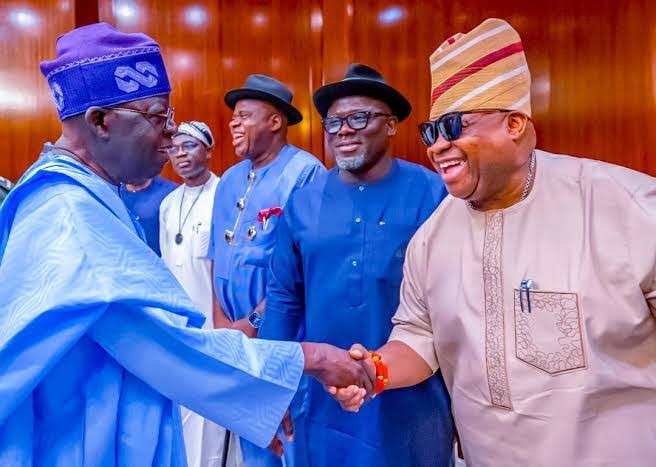
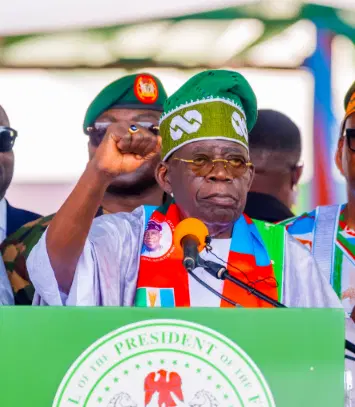
Photo file:Tinubu And Adeleke
Former Kaduna Central Senator, Shehu Sani, has described the emerging political relationship between Osun State Governor Ademola Adeleke and President Bola Tinubu as a mutually beneficial arrangement rather than a contradiction of their party differences.
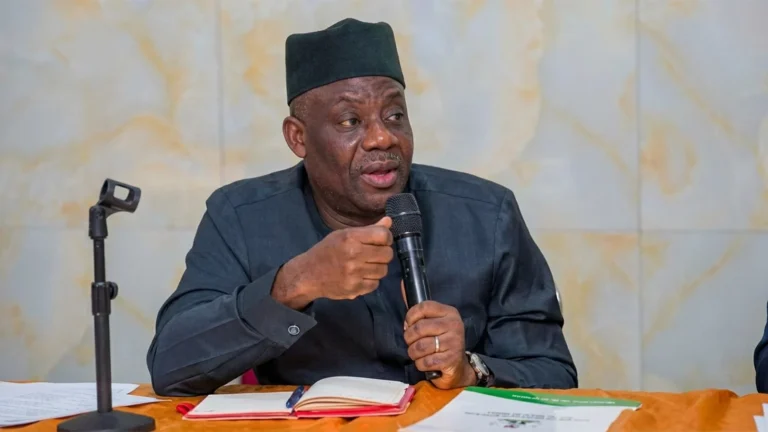
The former lawmaker made this known on Tuesday while speaking as a guest on Frontline, a current affairs programme on Eagle 102.5 FM, Ilese-Ijebu, Ogun State. Sani said both politicians had strong reasons to maintain a working relationship following Adeleke’s victory in the August 15 Osun governorship election.
Following his re-election victory in the August 15, 2026, Osun State governorship poll, Governor Ademola Adeleke publicly thanked President Bola Ahmed Tinubu for upholding democratic principles and ensuring a free, fair, and credible process. Contesting on the platform of the Accord Party, Adeleke secured a fresh four-year term with 511,067 votes to defeat Munirudeen Bola Oyebamiji of the All Progressives Congress (APC), who polled 444,815 votes. Speaking shortly after receiving a personal congratulatory phone call from the president, Adeleke praised Tinubu as a dedicated fighter for democracy and explicitly reaffirmed his full, cross-party endorsement of Tinubu’s 2027 presidential re-election bid, citing Southwest regional interest and structural solidarity.
owever, Adeleke continue to face severe public backlash from supporters and opposition critics who accuse him of political betrayal following his immediate endorsement of President Bola Ahmed Tinubu’s 2027 re-election bid. Netizens and political commentators on platforms like X (formerly Twitter) expressed deep disappointment, arguing that Adeleke’s premature alliance desecrates the sacrifices made by local voters. Critics emphasize that his submission to the center is particularly insulting given the heavy-handed federal interference leading up to the gubernatorial election where federal agencies and the ruling All Progressives Congress (APC) openly used state power to intimidate local officials and threaten to manipulate the democratic process.
Sani said the people of Osun State may not necessarily support Tinubu at the governorship level, just as supporters of Tinubu may not necessarily support Adeleke. According to him, the political relationship between Adeleke and Tinubu demonstrates the reality that political alliances in Nigeria are often driven by interests rather than party ideology.
However, he argued that both politicians had recognised the need to work together.
“The people of Adeleke may not like Tinubu, and the people of Tinubu may not like Adeleke,” he said.
“But Tinubu needs Adeleke for the fact that he needs the votes from Osun State. Adeleke needs Tinubu for protection against the hawks that are coming in between them.”
Sani said Adeleke remained popular among voters in Osun and had therefore become politically important to Tinubu ahead of the 2027 presidential election.
He also said Tinubu retained significant influence at the Federal Government level and could play a role in protecting Adeleke’s political interests.
The former senator pointed to the controversy surrounding the freezing of Osun State Government accounts by the Economic and Financial Crimes Commission as one example of the importance of their relationship.
He said Tinubu’s intervention in the matter was not something Adeleke could simply ignore.
“For Tinubu to stop the EFCC from freezing the account of Osun State, and he didn’t do it secretly, it was done openly for everyone to see,” Sani said.
He argued that a politician who understood the realities of the system would recognise such intervention as politically significant.
Sani said Adeleke’s public support for Tinubu’s re-election should therefore be understood in the context of the relationship between the two leaders.
“He has won his election, and Tinubu has stopped any form of interference to tamper with that,” he said.
The former lawmaker said Adeleke still had political battles ahead despite winning the governorship election.
He argued that some of those battles could require federal cooperation and political protection.
Sani also dismissed claims that the Osun election demonstrated the emergence of a strong opposition force capable of defeating the APC nationally.
He said the election should not simply be interpreted as an APC defeat because of the peculiar political relationship between Adeleke and Tinubu.
According to him, local political structures and individual interests played a significant role in determining the outcome.
Sani particularly criticised the African Democratic Congress over its performance in the election.
He said the party’s candidate, Najeem Salaam, secured only about 17,000 votes despite the party presenting itself as a major opposition platform.
He questioned why ADC leaders were focusing on the APC’s defeat instead of examining their own poor electoral performance.
“What was their scorecard in Osun State?” Sani asked.
He said the party should be more concerned about its own performance after failing to make a significant impact in the election.
Sani also questioned the seriousness of an opposition party seeking to win the presidency while failing to build strong structures at state and local levels.
He argued that presidential ambitions must be supported by candidates contesting lower offices because those candidates help build the political structures necessary for electoral success.
A serious presidential contender, according to him, must support candidates contesting the House of Assembly, House of Representatives, Senate and local government positions.
He said local political structures were particularly important because candidates closer to the people could mobilise voters for candidates contesting higher offices.
“If your candidates lost election, if your central candidates lost election, if your House of Assembly candidate lost election, and you say you want to be president of Nigeria, you are simply wasting your time,” Sani said.
He maintained that opposition parties could not build a credible national political structure by focusing exclusively on the presidency.
Sani said political strength must be built from the grassroots upward, with candidates at different levels working together to secure electoral victories.
He added that the Osun election exposed weaknesses within the ADC that the party must address if it intends to mount a serious challenge in 2027.
The former senator said the emerging relationship between Adeleke and Tinubu should therefore be seen as part of a wider political calculation ahead of the next general election.
He concluded that both politicians stood to benefit from maintaining their relationship, particularly where their interests intersect at the state and national levels.


 Eagle Fm