DANGOTE’S LABOUR PRACTICES BREACH NIGERIAN CONSTITUTION – OGUN TUC
Written by Oluwaseyi Amosun on September 9, 2025

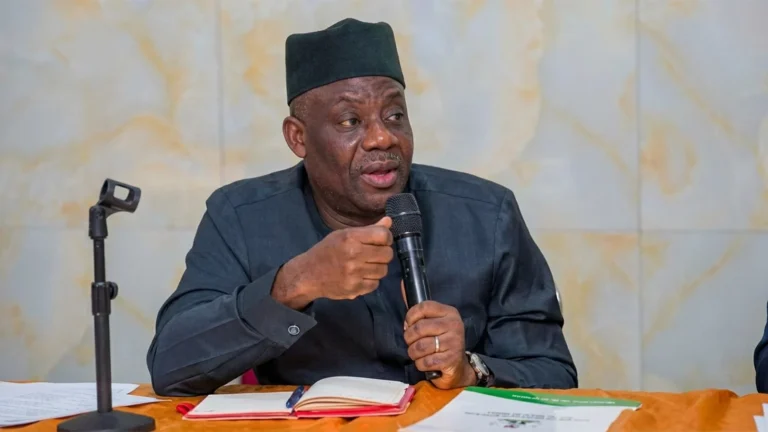
PHOTO FILE: Chairman of the Ogun State Council of the Trade Union Congress (TUC), Comrade Lasisi Akeem
The Chairman of the Ogun State Council of the Trade Union Congress (TUC), Comrade Lasisi Akeem, has accused the Dangote Group of violating workers’ rights by allegedly preventing its employees in the oil and gas sector from joining labour unions.
Speaking on Eagle 102.5FM’s Frontline today, Akeem argued that Dangote’s policy of non-unionisation contravenes both the Nigerian Constitution and the Trade Union Act.
Recall that negotiations between the Federal Government, organised labour, and the Dangote Group hit a roadblock late Monday in Abuja. Hence, scarcity of petroleum products may soon hit the country as members of the National Union of Petroleum and Natural Gas Workers (NUPENG) continue their strike on Tuesday.
Akeem said, “Dangote is one of the companies in the oil and gas sector paying lower wages. When workers are unionised, they will be able to speak out. I think this is not good enough because it contravenes Section 40 of the Nigerian Constitution.” He cited Section 12 of the Trade Union Act, which gives workers the right to freely join any union of their choice in order to speak collectively.
He warned that restricting union membership amounted to “enslaving workers,” noting, “If you don’t allow workers to unionise freely, that means you will be able to enslave them. That is why unions are saying no to this policy.”
According to Akeem, unionisation benefits employers as much as employees. He explained that unions help companies resolve internal grievances before they escalate into industrial action, adding that, “When workers are treated well, they will be mentally and physically balanced, thereby discharging their duties to the best of their ability. When you try to enslave your workers, it will affect their productivity.”
The TUC chairman alleged that Dangote’s refusal to allow unionisation has left workers vulnerable to poor pay and substandard working conditions. He stated, “Because Dangote refuses to unionise the workers, they cannot be heard. And this is not fair on them.”
Akeem added that staff of the company were “treated below acceptable standards” and paid less than their counterparts in the sector despite the oil and gas industry’s “special nature” and hazardous conditions. “But Dangote is paying the lowest in the oil and gas sector, and the reason is not far-fetched; the company will never allow workers to unionise there,” he said.
He gave an example of newly employed truck drivers at Dangote who have no collective bargaining power because they are not union members. “If you don’t join a union, your voice can never be heard,” he emphasised.
Reacting to the possibility of Dangote workers joining solidarity strikes with other unions, Akeem invoked the popular labour slogan, “An injury to one is an injury to all,” noting that issues at one company often “spread like wildfire” to others. He maintained that workers have the constitutional right to join any labour union “in order to protect their rights and privileges.”
When asked if the company also has a right to determine which union or association it associates with, Akeem countered that, “The Nigerian Constitution is above all other rights and privileges. We are to follow the Constitution to the last order.”
He stressed that no employer automatically prioritises the welfare of workers, saying it is up to workers themselves to demand their rights. Otherwise, “they will be treated as slaves.”
Responding to Dangote’s repeated claims about “cabals” in the oil and gas sector, Akeem denied any union involvement. “No,” he said firmly. “You will recall that the union was at the forefront of making sure that the cabal’s actions were stopped in the country. They were strongly against the cabals because they are affecting the upstream and downstream sectors of oil and gas.”
He added that unions were “not part of the cabal” but “at the frontline of making sure that workers’ rights are protected.” According to him, the union remains “the only voice” workers have to demand respect for their rights because “individually, they cannot talk.”
Akeem further criticised the practice of making prospective employees sign undertakings not to join unions. “Why should you mandate a prospective employee in your company to agree that they will never join any union if you don’t have an ulterior motive? It is against the Constitution of the country and the Trade Union Act,” he argued. Such practices, he said, were designed to maximise profits at workers’ expense.
On the potential impact of Dangote’s continued resistance to unionisation, Akeem warned that the policy could destabilise the sector. “You cannot treat us as slaves in our fatherland,” he said. “Why will you say workers should not be unionised? We are living in a country that has laws, and you want to act against the law. Whether private or public, the law is the same.”
He explained that industrial action is a last resort for unions. “There is no labour leader or reasonable Nigerian that will say they want to embark on industrial action all the time. It is only when unions are pushed to the wall that they use the only weapon that they have,” he said. Protests, picketing, and other internal measures are usually attempted before strikes.
Addressing calls for the union to approach the Industrial Court instead of shutting down the economy, Akeem stated, “We don’t need to go to court. We are acting within the ambit of the law. It is now left for the Dangote Refinery to report the matter in court.” He clarified that the Industrial Court is “never the first step” for labour unions and that it is typically the employer who initiates such actions.
Some critics have accused the union of prioritising its members’ interests over the economy, but Akeem dismissed this. “You cannot say that you want to improve the economy at the expense of your employees. It is not done anywhere. You cannot say you want to help me and also enslave me,” he said.
In his view, respecting workers’ rights under the law remains non-negotiable. He argued that only fair treatment, not suppression, can sustain both productivity and the national economy in the long term.


 Eagle Fm