DEFENCE MINISTER HOLDS EMERGENCY SECURITY MEETING AS INSECURITY DEEPENS ACROSS NIGERIA
Written by Oluwaseyi Amosun on March 11, 2026
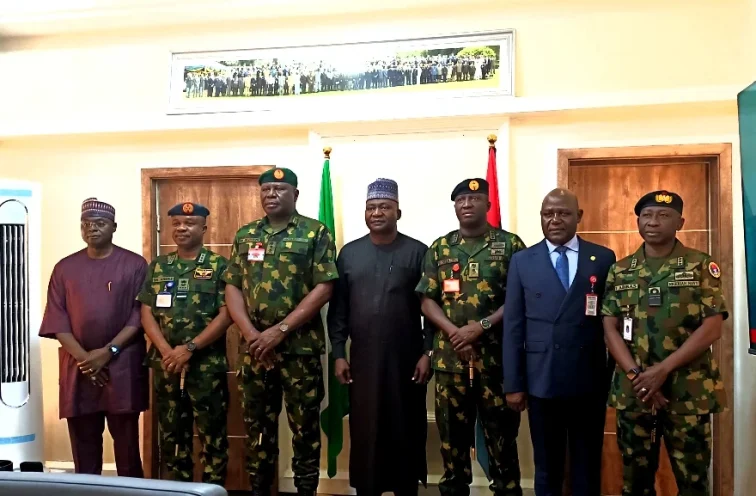
Nigeria’s Minister of Defence, General Christopher Musa (retd.), has convened an urgent high‑level meeting with all Service Chiefs at the Ministry of Defence headquarters in Abuja amid a worsening wave of insecurity sweeping the country.
The closed‑door session, which began on Wednesday, was called to deliberate on the surge in terrorist assaults on military formations in the North‑East and rising violent crimes nationwide. Present at the meeting are the Chief of Defence Staff, Gen. Olufemi Oluyede; Chief of Army Staff, Lt.‑Gen. Waidi Shaibu; Chief of Air Staff, Air Marshal Sunday Aneke; and Chief of Naval Staff, Vice Admiral Idi Abass, alongside representatives from the National Intelligence Agency and other security agencies.
The emergency consultations follow a series of coordinated jihadi attacks on Nigerian military bases in Borno and Yobe states, where extremist groups such as Boko Haram and its Islamic State West Africa Province (ISWAP) faction have exploited vulnerabilities to strike troop positions, seize weapons and inflict casualties on soldiers and officers in recent days. Analysts describe the attackers’ operations as highly coordinated, with at least four military officers killed and numerous soldiers lost amid the spate of raids.
Military records also show several Commanding Officers with the rank of Lieutenant‑Colonel were among the dead in the Borno theatre of operations, intensifying calls within the armed forces for strategic reassessment and renewed offensive momentum.
Nationwide Insecurity: South‑West and Middle Belt Communities in Protest

While insurgent activity persists in the Northeast, southern and central states are also grappling with fresh security alarms.
In Ondo State, residents of Akure North Local Government Area blocked the Akure‑Owo highway with the body of a slain community member after armed assailants killed two persons and abducted others. The demonstrators demanded urgent government action against persistent kidnappings and criminal incursions in their farming communities.
Similarly, in Oyo State, commuters and local residents disrupted the Ibadan–Oyo Expressway to protest a recent surge in kidnappings, banditry and attempted abductions, highlighting fears that insecurity is encroaching deeper into South‑West heartlands traditionally considered relatively secure.
Broader Security Picture: Rising Attacks and Human Cost
The broader security landscape shows a sharp escalation in violent incidents across Nigeria. A recent conflict report noted that in 2025 alone, violent confrontations, kidnappings and attacks claimed an estimated 4,654 lives, while 3,141 people were kidnapped in over 1,200 separate incidents, reflecting deepening instability that cuts across geopolitical zones.
Key flashpoints include:
- North‑East Insurgency – Jihadi groups continue to exploit gaps in troop deployments, leading to deadly assaults on military bases and civilians.
- Kwara State Massacre – In February 2026, Islamist militants reportedly killed more than 160 villagers in Nuku and Woro communities in an attack linked to extended Boko Haram and Lakurawa operations.
- Herder‑Farmer and Vigilante Violence – Various belts across central states have seen persistent clashes attributed to armed groups and communal feuds.
- South‑West Bandit and Kidnap Surge – Protests in Ondo and Oyo underscore the growing reach of criminal elements beyond the traditional conflict zones.
Security Leadership Reshuffle and Expectations
Amid these security challenges, President Bola Tinubu announced a shake‑up of the military command last year, appointing new Service Chiefs as part of a broader effort to revitalize Nigeria’s security architecture and redouble efforts against terrorism and other criminal threats.
General Musa, who previously served in top military command roles before his ministerial appointment, has vowed to harness both military might and strategic coordination to confront the multi‑dimensional security threats confronting Nigeria.
As the Defence Ministry deliberations continue, Nigerians await concrete directives from the meeting — including possible expansion of operations, revised tactical deployments, and inter‑agency collaboration to stem the escalating wave of violence.




 Eagle Fm