‘I HAVE NO REGRETS’ — NYIAM REOPENS THE 1990 ORKAR COUP DEBATE, LINKS PAST GRIEVANCES TO PRESENT-DAY NIGERIA
Written by Oluwaseyi Amosun on March 19, 2026

One of the principal actors in the 1990 Orkar coup attempt aimed at overthrowing the military government of Ibrahim Babangida, Retired Lieutenant-Colonel Tony Nyiam has declared that he has no regrets over his involvement, insisting that the grievances that drove the failed operation remain deeply rooted in Nigeria’s present-day reality.
Speaking during an exclusive interview on Frontline, a current affairs programme on Eagle 102.5 FM, Ilese-Ijebu, Ogun State, on Thursday, Nyiam reflected extensively on the political and security dynamics that informed the 1990 coup and what he sees as enduring structural flaws in Nigeria.
Recall that on the morning of April 22, 1990, Nigeria’s political landscape was shaken by a daring and violent coup attempt orchestrated by Major Gideon Orkar. At dawn, the rebels launched a ferocious assault on the Dodan Barracks in Lagos, then the nerve center of the military government, in a bid to overthrow General Ibrahim Babangida. While Babangida narrowly escaped the onslaught, Orkar and his co-conspirators seized the Federal Radio Corporation of Nigeria (FRCN), from where Orkar delivered a provocative broadcast declaring the temporary excision of five far-northern states from the federation.
The coup, which is often cited as one of the bloodiest in Nigeria’s history, had been compromised from within even before the first shots were fired.
Nyiam urged Nigerians to “connect the dots” between the objectives of past interventions, including the Orkar coup, and the contemporary challenges confronting the country. According to him, the motivations behind the 1990 operation were to confront forces within Nigeria that, in his view, sought to maintain a form of internal colonisation.
He emphasized that while the methods of the coup were flawed, the underlying grievances systemic injustice, marginalization, and institutional bias remain relevant decades later.
“Why would I regret being part of something that was aimed at correcting fundamental injustices? The issues we identified and tried to address over three decades ago are still very much with us today. In some cases, they have even worsened,” he said.
Tribute to Fallen Patriots
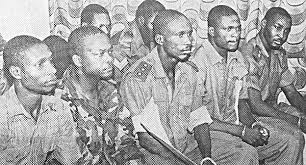
Nyiam paid tribute to his late colleague, Major Gideon Orkar, and other officers who lost their lives during the failed coup. He described them as patriots motivated by a genuine desire to build a better Nigeria.
“May the souls of Major Gideon Orkar and all those who paid the ultimate price rest in peace. These were men who believed in a better Nigeria and were willing to sacrifice everything for it,” Nyiam stated.
1990 Objective Admitted Errors
Despite defending the ideological basis of the operation, Nyiam admitted that strategic errors weakened its impact. He singled out overgeneralisation as a critical misstep, noting that it alienated potential allies within the military and contributed to divisions at a decisive stage of the operation.
“We made mistakes, no doubt about that. One of our major errors was overgeneralisation, which created divisions within our ranks at a critical moment. That affected the cohesion of the operation,” he explained.
He recounted how some Hausa officers and soldiers initially joined the coup plotters at Dodan Barracks but withdrew their support after hearing statements suggesting that their regions were being targeted. Nyiam said this episode highlights the challenges of navigating ethnic sensitivities in military and political operations.
“During the action, let me tell you this, the Hausa officers and soldiers who were in Dodan Barracks came over and joined us until they heard their states being excised on conditions,” he recalled.
Nyiam also contextualized the ongoing violence in northern Nigeria within this framework. He argued that the threats they foresaw in 1990 have now manifested in states like Zamfara and Katsina, where civilians continue to be killed. He underscored that even northerners are victims of these attacks, often by foreign elements exploiting Nigeria’s internal divisions.
“People in Zamfara are being killed. People in Katsina, they are being killed. The Hausas are being killed. More than anybody in the south. Why? They are being killed by people who are foreigners to our land,” he said.
According to Nyiam, Nigerian Fulanis cannot always intervene effectively because the attackers are often from across the Sahel, who view Nigeria’s fertile land as an opportunity while taking advantage of the country’s mutual distrust and short-term focus. He described this as an ongoing structural vulnerability that external actors exploit.
“Because they see our land so fertile and they see that we are vulnerable because of the mutual distrust we have… they exploit the contradictions of the Nigerian state. And they will continue,” he explained.
Turning to contemporary interventions, Nyiam highlighted what he saw as the positive impact of President Donald Trump’s involvement in Nigerian security affairs, arguing that it has invigorated the country’s security architecture. However, he stressed that such interventions should complement, not replace, a robust internal security system.
“That’s why some of us are happy that President Trump intervened. And we pray he continues to intervene. By the way, you would have noticed that President Trump’s intervention woke up Nigerian security architecture. Woke up everybody. And we pray it keeps on,” he said.
Security Concerns and the ‘Unfinished Warning’
Nyiam advocated for a multi-tiered security architecture that goes beyond state police to include homegrown security frameworks capable of addressing both insurgency and internal instability. He explained that while state police can maintain law and order, they are not equipped for larger, systemic threats.
The conversation then returned to the 1990 coup and Nyiam’s personal reflections on survival. He emphatically stated that he does not regret his involvement, framing his perspective within both historical context and contemporary realities.
“My brother, the evidence is very obvious with the answer. Why would I regret when Yorubas are being attacked in Kwara, while Yorubas in Osun and even Ogun state are under threat by the same people that we foresaw almost 25 years ago?” he remarked.
He recounted his experiences under General Muhammadu Buhari during the Shagari administration, particularly in relation to territorial disputes with Chad. He recalled Buhari’s principled stand to defend Nigerian islands, even when confronted with internal and financial pressures.
“General Muhammad Buhari told us, it was my commanding agency, when I was in Jos… Buhari said to us in the mess in Rukuba Barracks, Jos: most of my family are from Niger, but I am wearing a Nigerian Army uniform, so I would give loyalty to Nigeria,” Nyiam recalled.
He highlighted how Buhari’s commitment contrasted with other officers whose loyalties were tied more to ethnicity or external affiliations than to the nation. Nyiam said this tension contributed to the eventual dynamics that led to the Orkar coup and the shifting allegiances within the military at the time.
Nyiam further explained that the coup’s failure was exacerbated by internal betrayal. He named Colonel Patrick Fortata as the individual who leaked plans to Babangida, a revelation he said had grave consequences for the operation.
“The truth is that the operation was betrayed. The person who leaked the information was my colleague, Colonel Patrick Fortata. That betrayal played a significant role in the outcome of the operation,” he revealed.
Democracy on Trial: ‘Do We Truly Have It?’
He also reflected on the broader political system in Nigeria, noting that even decades after the coup, elections and governance continue to reflect structural manipulation rather than genuine democracy.
“We talk about democracy, but we must ask ourselves honestly—do we truly have democracy? Most of the elections conducted in this country have been deeply flawed. The system itself is designed in such a way that those who can manipulate it effectively are the ones who emerge victorious,” he said.
Nyiam acknowledged President Bola Ahmed Tinubu’s political rise, framing it as a product of Nigeria’s system rather than an exception to it. He argued that Tinubu’s success demonstrates mastery of a flawed structure rather than a triumph of democracy.
“President Tinubu understood the system and played it effectively. He mastered the political environment and achieved his objective. But that does not change the fact that the system itself needs to be reformed if we are serious about building a true democracy,” Nyiam asserted.
Comparing Tinubu to past leaders like Olusegun Obasanjo and Goodluck Jonathan, Nyiam argued that most previous leaders were either installed by others or emerged by chance, whereas Tinubu actively engineered his political ascent within the existing system.
He emphasized that the issue in Nigeria is not individual leadership but the structural incentives that reward strategic manipulation, a pattern he traced from historical episodes such as the 1990 coup to contemporary political arrangements.
Nyiam revisited historical precedents, particularly the leadership of Obafemi Awolowo and the federal arrangement of the First Republic, highlighting the competitive advantage that autonomous regional governance provided. He argued that Awolowo’s model allowed for innovation, development, and inclusive governance, something he sees as absent in modern Nigeria.
“If you allow people to govern themselves, there will be competition. I will come back to watch the kind of competition Awolowo did and the kind of governance Awolowo gave Nigeria,” he said.
On Intelligence and Security Profiling
On intelligence and security profiling, Nyiam criticized Nigeria’s inability to produce detailed profiles of criminals and terrorists, comparing it unfavorably with other nations. He argued that the problem is less about knowledge than systemic weakness and compromised institutions.
“It is not always about not knowing. Sometimes, it is about a system that is too weak, too compromised, or too constrained to act decisively on the information it has. That is why I keep coming back to the need for structural change,” he said.
Nyiam concluded by reiterating that Nigeria’s challenges—political, security, and economic—cannot be addressed through incremental reforms or by focusing on individual actors alone. He argued that fundamental structural reform is the only viable solution.
“What we need is not just a change of leaders, but a change of the system itself. Until we address the structural foundations of our problems, we will continue to go round in circles,” he concluded.
Caller’s Reactions
Throughout the interview, callers and participants raised pointed questions about regionalism, national loyalty, intelligence operations, and leadership appointments, all of which Nyiam used to reinforce his thesis: that Nigeria’s crises are embedded in structural flaws and historical misalignments.
He cited examples of ongoing regional insecurity, the composition of federal cabinets, and the operational limitations of police and military institutions, connecting them back to the 1990 Orkar coup as a warning that unaddressed systemic problems tend to persist.
Nyiam also touched on the consequences of loyalty and betrayal within military hierarchies, detailing how ideological commitment and ethnic allegiance often collide in complex ways that shape outcomes in both governance and security operations.
“I would rather have gone like Major Orkar went than to be living like he is living now,” he said, reflecting on the costs of principled action versus the compromises of survival within the system.
He highlighted the need for Nigerians to rethink the structure of federal governance, suggesting that regional autonomy similar to the First Republic’s model could create a competitive and innovative political environment.
Nyiam concluded that lessons from past military interventions, combined with contemporary challenges, underscore the urgency of structural reform, which he framed as the only path to sustainable stability, equitable development, and genuine democracy in Nigeria.


 Eagle Fm