“THE PRESIDENT DOES NOT NEED AN EXECUTIVE ORDER”: FALANA FAULTS THREAT OF DIRECT LG FUNDING ORDER
Written by Oluwaseyi Amosun on December 23, 2025

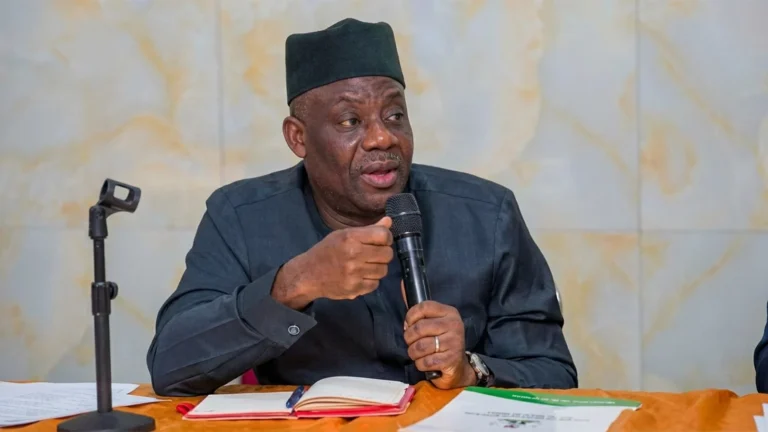
Image of the Senior Advocate of Nigeria, Femi Falana
A Senior Advocate of Nigeria, Femi Falana has argued that President Bola Tinubu does not require an executive order to give effect to the Supreme Court judgement granting financial autonomy to local governments, insisting that the responsibility lies with the State Government to immediately comply with the ruling.
He made this known during an exclusive interview on Frontline, a current affairs programme, on Eagle 102.5 FM, Ilese, Ijebu, on Tuesday, following remarks made by President Tinubu at the 15th National Executive Committee meeting of the All Progressives Congress, where he warned governors to comply with the Supreme Court judgement or face a possible executive order mandating direct disbursement of funds to local councils.
Falana was unequivocal in his response, insisting that the President does not require any executive order to give effect to the Supreme Court’s decision.
“I’m not sure the President was properly advised on this matter,” Falana said. “The Supreme Court already gave a judgement. What is required is compliance, not another executive action.”
He explained that the Supreme Court had expressly directed the Central Bank of Nigeria and the Accountant-General of the Federation to remit statutory allocations directly to the bank accounts of the 774 local governments. According to him, those accounts were opened last year in compliance with the ruling.
“What we are witnessing is not disobedience by state governments,” Falana added. “It is the federal government that has failed or refused to comply with the judgement by not paying the allocations into those accounts.”
Addressing the suggestion of an executive order, Falana warned that such a move would be unnecessary and potentially counterproductive.
“The President does not need to threaten anybody with an executive order,” he said. “All he needs to do is to direct the Accountant-General of the Federation that whenever statutory allocations are shared, starting from December 2025, the money should be paid directly to the bank accounts of the local governments.”
He cited Section 287 of the Constitution, which mandates all authorities and persons to obey Supreme Court judgements, stressing that once the apex court has spoken, there is no room for discretion or delay.
“When the Supreme Court gives a judgement, there can be no appeal against it. You cannot dance around it,” Falana stated, describing continued non-compliance as “a dangerous precedent in a democracy.”
TRANSPARENCY AND PUBLIC ACCOUNTABILITY
Falana also called for the restoration of a transparency framework that previously allowed Nigerians to track public funds across all tiers of government.
“Statutory allocations to the federal, state and local governments must be published monthly,” he said. “That way, members of the public can monitor the movement of funds and hold their local governments accountable.”
He argued that once salaries are paid, citizens should be able to ask what councils are doing with the remaining funds, noting that transparency, not executive threats, is the real safeguard against misuse.
EXECUTIVE ORDERS AND PAST COURT RULINGS
Drawing from recent history, Falana recalled that former President Muhammadu Buhari’s Executive Order 10 of 2020 was challenged by governors and eventually struck down by the Supreme Court.
“That is why this issue is not about executive orders,” he said. “What is important now is to obey the Supreme Court judgement and ensure that funds are paid directly to local governments, as ordered.”
BROADER LEGAL CONTEXT
The legal luminary dismissed claims that legislative bottlenecks were responsible for the delay in implementing local government autonomy.
“There is already a judgement on this matter,” he said. “The Constitution provided for joint state-local government accounts, but the Supreme Court has said that provision can no longer stand. The money must go directly to local governments.”
He expressed confidence that the President would ultimately be “properly admonished” and guided to take the constitutionally correct steps.
“In a democracy, once the Supreme Court has spoken, compliance is not optional,” Falana said. “Our duty now is to enforce the law, not to threaten, delay or politicise it.”


 Eagle Fm