TRUMP SLAPS 35% TARIFF ON CANADA AMID SWEEPING GLOBAL TRADE OFFENSIVE
Written by Oluwaseyi Amosun on August 1, 2025

U.S. President Donald Trump delivers remarks during a signing ceremony for the “GENIUS Act” in the East Room of the White House on on July 18, 2025, in Washington, DC. (Photo by Anna Moneymaker / GETTY IMAGES NORTH AMERICA / Getty Images via AFP)
Former U.S. President Donald Trump on Thursday unveiled a sweeping tariff regime that targets nearly 70 countries, escalating his protectionist trade agenda with a particularly sharp blow to neighbouring Canada, which now faces a 35% tariff on its exports to the United States.
The tariffs, part of a broader strategy to reshape global trade in favour of American manufacturing, mark one of the largest coordinated tariff hikes in recent U.S. history. While most of the new duties will take effect in a week—allowing room for last-minute diplomacy—Canada’s hike begins immediately, with no grace period.
The White House says the goal is to strengthen American industries and reduce dependence on foreign goods. However, the move has already sparked concern among global economists and trade analysts who fear it could stoke inflation and destabilise international trade frameworks.
Trump had previously imposed a 10% tariff across a wide range of imports in April, citing “reciprocal” trade injustices. Thursday’s executive order replaces that blanket duty with country-specific rates, ranging as high as 41%. Additionally, the order imposes a 40% penalty on any goods rerouted through third countries to avoid tariffs—a direct shot at transshipping practices.
While the tariffs are largely framed as economic measures, Trump’s decision to target Canada appears deeply political. The former president took aim at Canadian Prime Minister Mark Carney following Canada’s announcement that it would back Palestinian statehood at the upcoming UN General Assembly in September. “Wow! Canada has just announced that it is backing statehood for Palestine,” Trump posted on his social platform, Truth Social. “That will make it very hard for us to make a trade deal with them.”
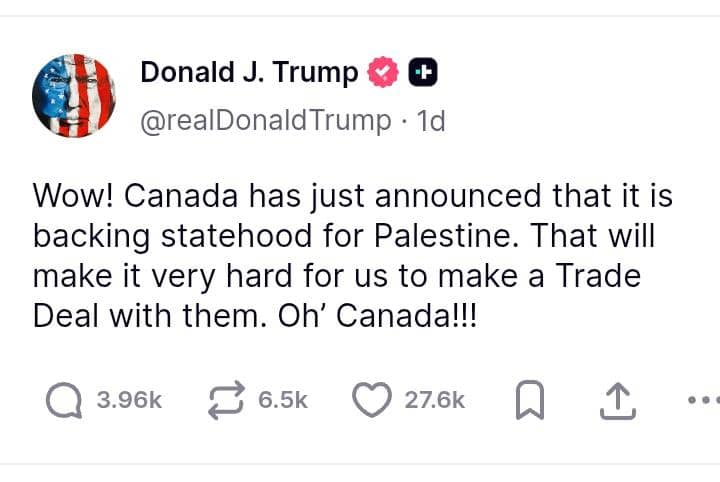
In contrast, Mexico received a 90-day extension before its tariffs rose from 25% to 30%, following negotiations with Mexican President Claudia Sheinbaum. Trump’s order also maintains some carve-outs under the existing North American trade agreement, allowing specific exemptions for both Mexico and Canada.
Other countries caught in Trump’s tariff net include Switzerland, which now faces a 39% duty, and Taiwan, which received a slight reprieve with tariffs reduced to 20% from a previously proposed 32%. In Southeast Asia, Cambodia and Thailand saw their threatened tariffs of 49% and 36% reduced to 19% each after diplomatic interventions.
Countries that managed to negotiate exemptions or softer terms include Vietnam, Japan, Indonesia, the Philippines, South Korea, and the European Union. The United Kingdom, though not initially targeted, also secured a bilateral deal to avoid punitive measures.
Notably, China was excluded from Thursday’s announcement. However, it faces a looming August 12 deadline, after which previous tariff reductions could be reversed if no agreement is reached. At the peak of their trade war, Washington and Beijing had imposed tit-for-tat duties exceeding 100% on select goods. A fragile truce remains in place.
Trump’s use of executive powers to impose such wide-ranging tariffs is facing legal scrutiny. The U.S. Court of Appeals is currently hearing challenges to the legality of these actions, after a lower court ruled that Trump may have exceeded his authority under emergency economic powers legislation.
Despite the looming legal threats, Trump defended the tariffs as necessary for national survival. “The U.S. economy has no chance of survival or success without tariffs,” he declared in a press briefing.
Economists, however, remain divided. While some argue that tariffs can offer temporary relief to domestic industries, many warn of long-term inflation, reduced global competitiveness, and the unravelling of multilateral trade systems that have existed since World War II. “This executive order tears up the trade rulebook that has governed international trade since World War II,” said Wendy Cutler, vice president of the Asia Society Policy Institute. “Whether our partners can preserve it without the United States is an open question.”
Trump, who has made tariffs central to his political identity, is likely to continue pushing this agenda as a pillar of his campaign. But with inflationary risks, legal battles, and diplomatic tensions mounting, the ultimate cost of this bold strategy—for both the U.S. and its trading partners—remains to be seen.


 Eagle Fm