‘TRUMP’S STATEMENT A WARNING SHOT,’ SAYS BODE GEORGE
Written by Oluwaseyi Amosun on November 4, 2025

Chief Bode George
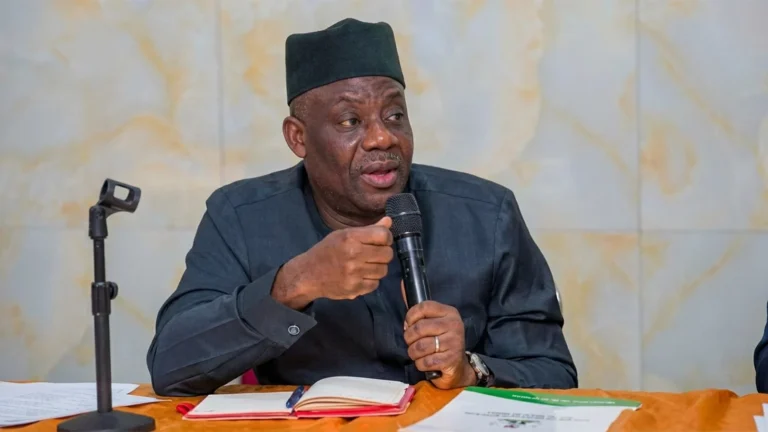
Former Deputy National Chairman of the Peoples Democratic Party (PDP), Chief Olabode George, has described United States President Donald Trump’s recent statement on Nigeria as “a warning shot,” saying it signaled how dangerously misunderstood the country’s internal crisis has become on the global stage.
Recall that the United States Secretary of Defense, Peter Brian Hegseth has confirmed that the Department of War is making preparations for invasion of Nigeria.
Hegseth’s confirmation came on Saturday shortly after President Donald Trump accused the Nigerian government of allowing what he described as the continued massacre of Christians—an allegation the Nigerian authorities have repeatedly and firmly denied.
Speaking on Tuesday, in an exclusive interview on Frontline, a current affair programme on Eagle 102.5 FM, Ilese Ijebu, George said “As a naval officer, I interpret Trump’s statement as a warning shot”.
When a president makes such remarks, followed by his Secretary of State and Defense, it means something strategic is being discussed. Someone is feeding the world the wrong information about Nigeria.” He added.
He also warned that foreign powers could easily misinterpret Nigeria’s domestic challenges as religious persecution, thereby exposing the country to unnecessary diplomatic strain.
“That’s how they start,” he cautioned. “They gather intelligence, draw conclusions, and before you know it, they tag your nation unsafe. I hope our government takes this seriously because the consequences could be far-reaching.”
‘Nigeria’s Problem is Hunger, Not Religion’
George dismissed claims that Nigeria’s persistent insecurity stemmed from faith-based conflict, saying such views were both simplistic and untrue.
“Religion is not our problem,” he said firmly. “Almost every Nigerian family has Christians, Muslims, and traditional believers living together peacefully. What we have is hunger, unemployment, and hopelessness — and when people are hungry, they lose reason.”
He lamented the rise in economic hardship across the country, describing the current situation as a “national emergency” that could breed social explosion if not urgently addressed.
“Every day, young people come to me begging for food or transport,” he revealed. “We deceive ourselves by pretending things are fine. Hunger is in the land, and hunger breeds anger. It’s only a matter of time before frustration turns to rebellion.”
Calls for a Poverty Alleviation Fund
The PDP chieftain proposed the creation of a National Poverty Alleviation Fund that would finance vocational training and small-scale enterprise development for unemployed youths.
“You can’t have millions of idle young minds and expect peace,” George said. “Give them carpentry, tailoring, ICT, painting, whatever skill keeps them busy. When they are tooled up, they will not be manipulated into crime or violence.”
He condemned the discontinuation of youth-oriented programs initiated under past administrations.
“During Jonathan’s time, we had skill centers and community programs. Buhari came and scrapped them. Now we are paying the price,” he noted.
State Policing and Security Coordination
George also called for the urgent adoption of state policing, arguing that the centralized structure of Nigeria’s police force made it inefficient and overstretched.
“We have less than 400,000 policemen in a country of over 200 million people,” he observed. “How can that work? State police will know their terrain, their people, their language. It’s the only way to tackle insecurity from the grassroots.”
He emphasized the need for better intelligence sharing among the police, DSS, and military, saying poor coordination often allowed minor issues to escalate into crises.
“Some of what America hears comes from social media and unverified briefings,” he warned. “We must control our narrative by fixing our internal lapses.”
Tribalism, Religion and the Colonial Legacy
The elder statesman linked the country’s recurring divisions to what he described as the “colonial relics” left behind by the British.
“When the British left, they left us two terrible evils — tribalism and religious bigotry,” George recalled. “Any time there’s a national problem, these two rise to the surface. Until we face them squarely, we will keep repeating history.”
Despite his frustration, George expressed optimism that the nation could still find redemption through sincere leadership and structural reform.
“Nigeria can be fixed,” he said quietly. “We have the people, the experience, and the intellect. What we lack is sincerity, discipline, and the will to coordinate our strengths.”


 Eagle Fm